Design No. 1034
Heatherbell
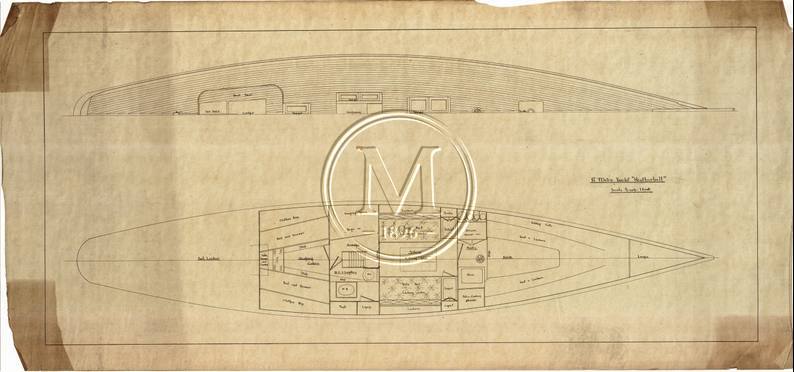
Design 1034 represents Alfred Mylne's work in the International Metre Class, a one-design racing class that emerged during the early twentieth century. The design yielded at least one known vessel, Heatherbell, built in 1907. The International Metre Class attracted considerable interest among racing yacht owners during this period, reflecting contemporary preferences for standardised competitive yachting.
Original Drawings · 1 sheet
Dimensions
Notes
Courtessy http://www.12mrclass.com Built according to the International First Rule. 1907 - 1908 Major Andrew Coats (uncle of the designer) - name: Heatherbell - home port: Glasgow (Great Britain). The interior was finished in cedar throughout, ladies cabin and saloon in white enamel with polished dado. Forecastle fitted out with beds for 5 men. The contract price, excluding sails was ? 1,750. The yacht was built in July, at the busiest time of the year, requiring constant overtime, which added considerably to the overall cost. She competed without success in the English trials for the 1908 Olympic games. In November, she underwent a course of treatment: the weakness of spars was corrected; she was cleared up below, with the object of lightening her wherever possible; the cleats and and sheet-leads were shifted; the rail was moved to the edge of the deck, so that the sheets and runners would lead straighter; the skylights were removed and replaced by others of lighter make; all the blocks and gear were lightened. 1909 - 1915 Ernst Krogius, Yacht Club deputy commodore - home port: Helsingfors (Finland). She represented Finland in 1912 Olympic Games winning the bronze medal. According to Lloyd's Register the yacht was also named Teresita. 1916 - 1918 Harald Zetterstrom syndicate. The original lead keel was removed in 1917 and replaced by a concrete one. 1919 Gustav Eslander. 1920 - 1923 Niels M. Magnussen - new name: Margit IV - home port: Christiania, Oslo (Norway). Since 1920 in Lloyd's Register was registered as "formerly Int. Rating Class 12 Metres". 1924 C.E. Nicholson - home port: Portsmouth (Great Britain). 1925 - 1926 P.C. Merillon - from 1926 new name: Yolande - from 1926 home port: Cannes (France). In 1925 she was altered as "auxiliary Bermudian cutter" and an engine was installed. 1927 - 1949 Comte Jean de Polignac - new name: Sylva - home port: Antibes (France). Rig altered to yawl. Repowered with a Baudoin petrol engine in 1936. 1 950 - 1953 Conte Guy de Boisrouvray, a relative of Comte de Polignacn died in 1943 - home port: Antibes and Golfe Juan (France). 1954 - 1960 Andre and Georges Auniac. 1961 - 1963 Andre Comette. 1964 Disappeared from the Lloyd's Register. According to rumors, she should be still sailing in Norway but this news has not yet been confirmed.
Yachts in the Register · 1
Historical Context
The International Metre Class emerged in the early twentieth century as a response to growing enthusiasm for standardised yacht racing. Unlike earlier one-design classes where all yachts were theoretically identical, the Metre Class system employed a mathematical formula to govern design parameters, permitting individual variation whilst maintaining competitive fairness. Alfred Mylne operated during a period of significant innovation in yacht design and racing class development. His practice encompassed various racing and cruising designs, reflecting the diverse interests of his clientele. The appearance of design 1034 in his archive indicates his participation in the competitive racing market of the Edwardian era.