Trefoil of Kames
Trefoil of Kames is a 28-foot auxiliary cutter built in 1950 by Bute Slip Dock Company at Ardmaleish, to Design 414 by Alfred Mylne I and II. The third yacht constructed to this design, she was built in mahogany on oak frames with a pine deck for Jean Keppie, who purchased her while still under construction and took delivery at Colintraive in August 1950. Named in reference to the Girl Guide emblem, Trefoil of Kames proved a capable cruising yacht, combining seaworthiness, comfort and performance. Jean Keppie sailed her extensively for over fifty years before the yacht was sold in 2004 to Robin Wishart, who undertook substantial restoration.
Specification
Details
Registry & Identity
History & Notes
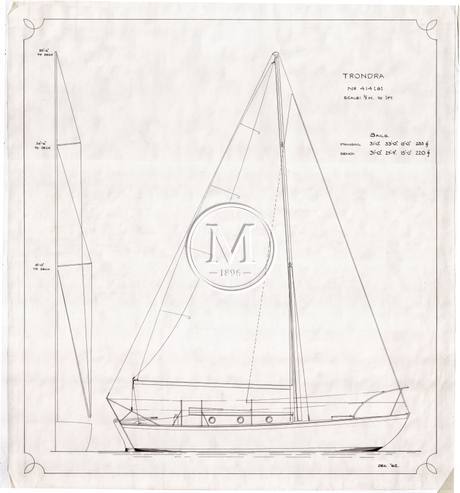
Design No.414 - Cruiser Designed by Alfred Mylne I & II for Jean Keppie GENERAL PARTICULARS Length over All - 28.2ft, Length Waterline - 23ft, Beam - 8ft, Draft - 4.75ft, Original Sail Area - 367ft², Designed - 1948, YACHTS BUILT Fraoich, ex-Flyaway, Sail No 149C - 1951 by Bute Slip Dock, Bute, Isla, ex-Fly Away, Tresta, Sail No 148C - 1948 by Bute Slip Dock, Bute, Trefoil of Kames., Sail No 5C - 1950 by Bute Slip Dock, Bute, Trondra, ex-Maranathea, Sail No 78C - 1949 by Bute Slip Dock, Bute Trefoil of Kames was built in 1950 at the Bute Slip Dock Company’s yard at Ardmaleish, the third yacht constructed to this 28-foot Alfred Mylne design. Jean Keppie, then a young widow with two daughters, bought the yacht while she was still partly completed and took delivery at Colintraive that August. She chose the name Trefoil in reference to the Girl Guide emblem, although the registered name became Trefoil of Kames because another vessel already carried the shorter name. Built in mahogany on oak frames with a pine deck, she was a strongly constructed long-keel cruising yacht with four berths and a reputation for combining seaworthiness, comfort and unexpectedly good performance. Jean owned and sailed Trefoil for more than fifty years, cruising thousands of miles around the Clyde, the west coast of Scotland and the Hebrides, while also racing her successfully in Clyde Cruising Club events. Among her early achievements were victory in class and first over the line in the 1951 Tobermory Race, while she later became particularly associated with the Round Bute Race and survived several notably severe passages. Jean and her crews also contributed practical knowledge to the Clyde Cruising Club’s sailing directions and charts. In 2004, approaching the age of ninety, Jean sold the yacht to Robin Wishart, who undertook an extensive restoration at Bute, renewing the hull finishes, cockpit, interior, machinery installation and other systems while continuing to cruise and race her.
Design Archive
Sister Yachts
3 other vessels built to the same design.
Historical Context
Design 414 emerged during the post-war years when A. Mylne & Co. was producing a series of proven cruising designs suited to Scottish coastal waters. The late 1940s represented a period of revival for yacht design and construction after the Second World War, with Bute Slip Dock establishing itself as a reliable builder of Mylne designs. The four vessels constructed to Design 414 exemplify the office's focus on practical, seaworthy cruising auxiliaries rather than racing machines. Trefoil of Kames's fifty-year association with Jean Keppie and the Clyde Cruising Club reflects the close relationship between Mylne designs and the active sailing community of the Firth of Clyde and west coast during the latter twentieth century.
Ownership
Current owner
Mr Robin Wishart
Since Jun 2004
Recorded on payment — claim #25
Crew
No crew records yet. If you’ve sailed on this yacht, claim your place in her history.